Verse in Unreal Engine: What You Need to Know
What Verse is, why Unreal Engine 6 is built on it, when to learn it, and how Ludus AI is working toward project-aware Verse support.
Verse in Unreal Engine: What You Need to Know
Verse is the programming language Unreal Engine 6 is being built on. It has been running in production inside Unreal Editor for Fortnite since March 2023, it powers gameplay scripting for tens of thousands of Fortnite Creative islands, and on June 17, 2026, Epic confirmed it will be the foundation of Scene Graph, the gameplay framework replacing the Actor system in UE6. You do not need to write a line of Verse to ship on UE5 today. But if you plan to be developing in Unreal past 2028, Verse is likely to become part of your work. Ludus AI is a project-aware assistant used by more than 35,000 Unreal developers, and we are working to extend it with Verse support as UE6 evolves.
Here is what Verse actually is, why Epic is building UE6 around it, when you genuinely need to care, and what project-aware Verse assistance could offer as the engine evolves.
What is Verse in Unreal Engine?
Verse is a multi-paradigm programming language designed by Epic with input from Simon Peyton Jones, co-creator of Haskell. It draws from functional, logic, and imperative traditions to solve a problem neither Blueprints nor C++ were designed for: massive, persistent, multiplayer worlds where synchronized state and concurrency just work.
Four features define it in practice:
Software transactional memory. Verse functions already use transactional semantics that can roll back and resimulate when needed. Today, Verse runs on a single thread. Epic says it is working toward distributed transactional memory for UE6, which is intended to distribute single-threaded-style Verse code across servers and simplify persistence and synchronization.
A first-class failure system. Expressions can fail gracefully as a language-level construct. Entire categories of null checks, and yes, entire categories of the Accessed None, get replaced by something the compiler reasons about for you.
Structured concurrency. Asynchronous gameplay logic without callback spaghetti or manual thread management. Timers, delays, and parallel behaviors are language primitives, not workarounds.
Familiar syntax. Epic explicitly designed Verse to feel approachable to anyone who has written Python or C#. The concepts are new. The typing experience is not alien.
Why is Epic building Unreal Engine 6 on Verse?
Because UE6 is not an incremental update. It merges Unreal Engine 5 and UEFN into a single unified engine, and its new gameplay framework, Scene Graph, is built from scratch on Verse. Epic's stated reason is scale: persistent, large-scale live experiences with thousands of contributors, where content and code stay portable across games and ecosystems.
C++ is not being removed from the engine. It remains the language of plugins, rendering, and core systems. What changes is the gameplay layer: Verse displaces C++ as the primary language for gameplay programming, and Scene Graph eventually sits where the Actor system sits today. Blueprints follow the same trajectory: fully supported in UE6 Early Access and initial releases, deprecated only once the Verse framework is sufficiently mature, with conversion tools committed before anything is retired.
When do you actually need to learn Verse?
Not this year, if you are shipping on UE5. UE 5.8 remains the stable production target, and everything you build today carries forward. UE6 Early Access is targeted for the end of 2027, with full release expected 12 to 18 months after that. The runway is measured in years.
But there is a difference between "not required yet" and "not worth starting." Verse is live and free to use in UEFN right now. Its core ideas, failure contexts, transactional state, concurrency primitives, take time to internalize, and that internalization compounds. A developer who has built two small UEFN projects in Verse by 2027 will onboard onto Scene Graph in days. A developer who first opens the docs at Early Access will spend months rebuilding intuition.
The practical guidance: keep shipping on UE5, keep your Blueprint architecture clean because the promised conversion tools will reward structure, and give Verse a low-stakes side project in UEFN before 2027. Consider tooling that can make the jump with you, because project context can reduce part of the transition cost.
Can AI assistants help you with Verse today?
Partially, and the gap is exactly where you would expect it.
General-purpose language models can explain Verse syntax. The language has been public since March 2023, its documentation is indexed, and asking a chatbot how a failure context works can produce a useful starting point. Epic is also building native MCP integrations into the UE6 development pipeline, with connections for Claude, Gemini, and others, which will let general-purpose models call editor tools directly.
Without direct project integration, a general model explaining Verse does not know your class hierarchy, naming conventions, or how your existing Blueprint systems connect. An MCP integration can expose editor commands, while persistent project context can reduce how much information must be rediscovered between requests. During an engine transition, when Blueprints, C++, and Verse may coexist in the same codebase, that context can help generated logic fit the right place and language.
Closing that gap for Verse is exactly what we are building.
Ludus AI: working toward project-aware Verse support
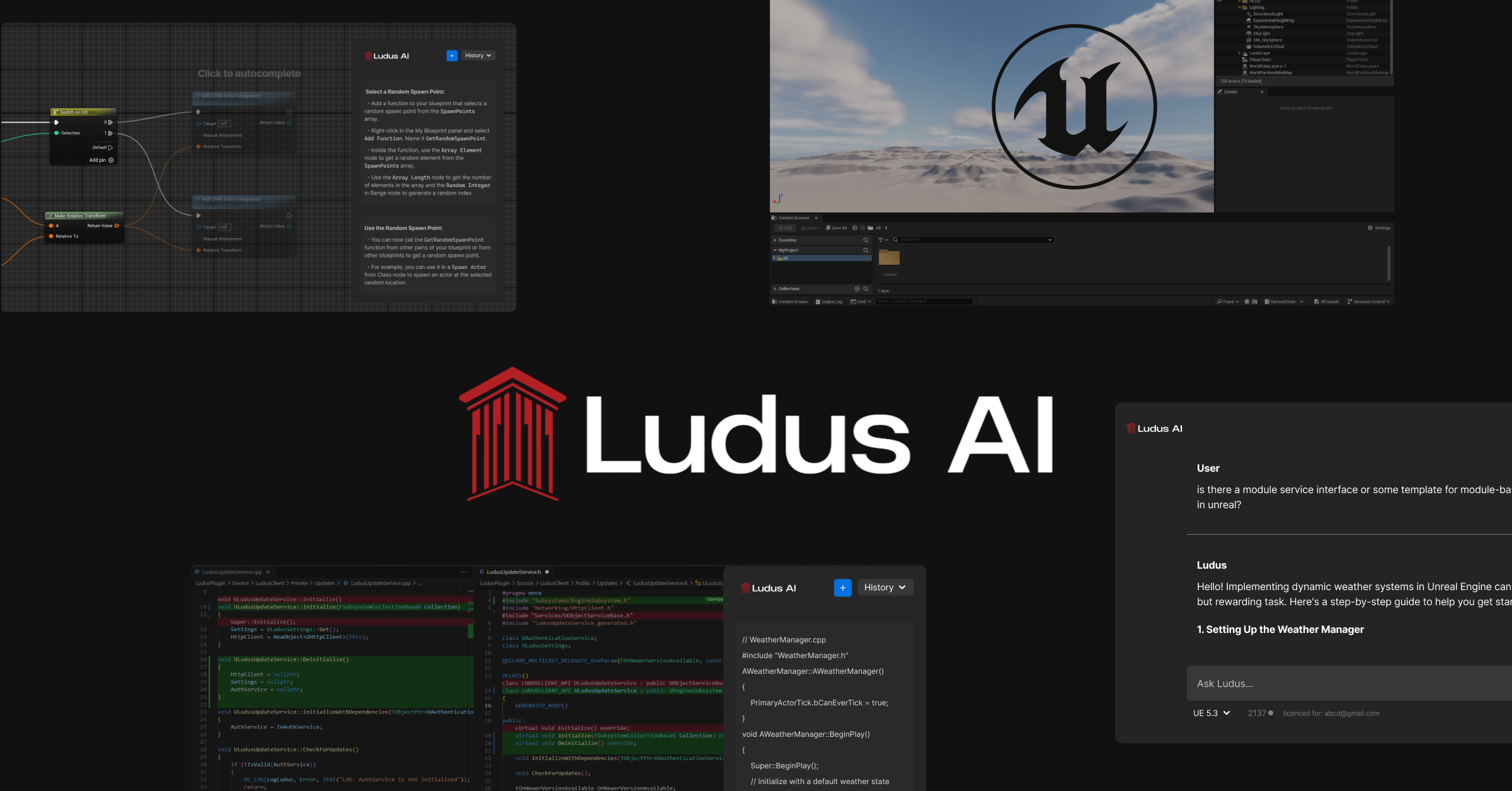
Ludus AI runs inside the Unreal Editor and is designed to build project context from Blueprints, C++, assets, naming conventions, and class hierarchy. It can generate Blueprint changes and asks for approval before applying them. This project-aware, approval-first architecture aims to reduce repeated project discovery and keep proposed changes grounded in the editor.
We are working to extend that architecture to Verse as UE6 evolves, with the goal of understanding, explaining, and generating Verse in the context of an actual project.
The planned experience includes:
Generating Verse for your project, not a hypothetical one. The goal is to turn a plain-language description into Verse that accounts for your naming, existing systems, and Scene Graph structure.
Answering Verse questions grounded in your codebase. We aim for answers about failure contexts, Blueprint boundaries, and concurrency primitives to account for what is actually in your project rather than only a generic example.
Navigating a three-language codebase as one project. Projects may mix Blueprints, C++, and Verse during the transition. We are designing Ludus AI to reason across those layers so proposed logic can land in the appropriate place and language.
Helping teams prepare for migration. Project-aware explanations can help teams understand existing Blueprint systems before Epic's migration tools ship.
A new language requires teams to rebuild intuition as well as learn syntax. Project-aware assistance is intended to make that transition easier by connecting new Verse concepts to the systems a team already has.
Verse and UE6 support: our roadmap
Our roadmap includes Unreal Engine 6 and Verse support. We are extending Ludus AI's project-aware architecture to understand, explain, and generate Verse alongside Blueprints and C++, while retaining its approval-first workflow. Our goal is to make that support useful as UE6 becomes ready for production, with scope and timing following Epic's evolving release.
FAQ
What is Verse in Unreal Engine?
Verse is Epic's programming language, live in UEFN since March 2023 and the foundation of Unreal Engine 6's Scene Graph gameplay framework. It combines functional, logic, and imperative programming with transactional memory and structured concurrency, built for persistent multiplayer worlds.
Do I need to learn Verse now?
Not for UE5 production work. UE 5.8 remains the stable target and Blueprints stay fully supported into UE6. But Verse is free to try in UEFN today, and early familiarity with its concepts will pay off when UE6 Early Access ships at the end of 2027.
Will Verse replace C++ in Unreal Engine?
Verse replaces C++ as the primary gameplay programming language in UE6's Scene Graph framework. C++ remains the language for engine plugins, rendering, and performance-critical core systems. Gameplay logic is what moves to Verse.
Is Verse hard to learn?
Epic designed Verse to feel familiar to anyone with Python or C# experience. The syntax is approachable; the new concepts are failure contexts, transactional state, and structured concurrency, which take deliberate practice to internalize.
Can ChatGPT or Claude write Verse code?
They can explain Verse syntax, since the language has been public since 2023. What general models cannot do is write Verse that fits your specific project, because they have no awareness of your class hierarchy, conventions, or existing systems. That requires project-aware tooling.
Will Ludus AI support Verse in Unreal Engine 6?
Verse and Unreal Engine 6 support are on the Ludus AI roadmap. We are working to extend its project-aware architecture to understand, explain, and generate Verse alongside Blueprints and C++, with the same approval-first workflow. Availability and scope will follow Epic's evolving UE6 release.
Ready to build with a project-aware Unreal Engine assistant?